

October 2025 | News
Advancing Lunar Exploration: City Labs at the 2025 NIAC Symposium
City Labs was honored to present at NASA’s 2025 NIAC Symposium, where the spotlight shone on advanced ideas driving the future of space. The NASA Innovative Advanced Concepts (NIAC) program is NASA’s incubator for bold concepts that have the potential to reshape what’s possible in space exploration. City Labs attended this symposium as recipients of a 2025 NIAC Phase 2 award, which expands the successful results from our 2024 Phase 1 award.

We used this platform not just to showcase what we’ve built so far, but to underscore how far NanoTritium™ technology has come, and where we’re headed next. At the event, City Labs’ CEO Peter Cabauy, Senior Scientist Mark Stone, and our long-time collaborator Mason Peck (Professor at Cornell and former NASA Chief Technologist) explored the potential of NanoTritium™ micropowered sensors as a foundation for sustained lunar operations, especially in regions where sunlight never reaches.
Power Where Sunlight Fails
Our core message: the Moon’s permanently shadowed regions (PSRs) pose one of the harshest environments for power systems. These regions are among the coldest known places in the solar system, with temperatures plunging below –200 °C. They also harbor deposits of water ice, making them crucial targets for both scientific discovery and the future of human presence on the Moon.
But powering systems in these areas is notoriously difficult, with solar panels not functioning in regions of the Moon’s south pole that remain in permanent darkness. In addition to the extreme cold, making it difficult for conventional electronics to function, traditional batteries degrade quickly and require replacement cycles that are simply not feasible in such remote environments.
City Labs is addressing this challenge with autonomous tritium-powered sensors designed to operate continuously—without the need for maintenance or recharging. These sensors are being developed as part of our Autonomous Tritium Micropowered Sensors project, which is focused on enabling arrays of miniaturized instruments that can survive and function in the lunar south pole’s extreme conditions.
Because they rely on the steady decay energy of tritium rather than sunlight or chemical reactions, they remain reliable where other systems shut down. This makes them ideal for distributed networks of instruments that can monitor temperature, radiation, seismic activity, or resource deposits for decades at a time.
During the Symposium, we shared how the NanoTritium™ platform solves critical constraints:
- Endurance: Decades-long continuous operation, avoiding costly maintenance cycles.
- Compactness: Small form factors, enabling distributed sensor swarms and integration into tight designs.
- Environmental resilience: Stable across extreme temperature swings, radiation, and vibration.
Proven Through Collaboration
City Labs’ central message during the Symposium was the vision for an autonomous tritium-micropowered sensor that builds on a foundation of City Labs’ proven NanoTritium™ technology, now being extended into new scientific territory as part of a Phase 2 project.
Over the years, City Labs has worked with NASA, Lockheed Martin, and the United States Space Force to develop and augment NanoTritium™ technology under demanding aerospace conditions. Those collaborations established confidence in the core power technology itself, verifying its durability, wide temperature range, and long-term reliability.
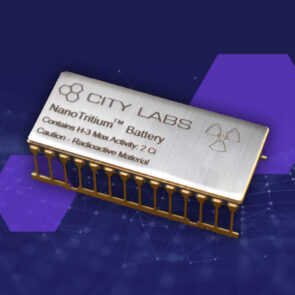
Within the NIAC framework, we are now exploring an entirely new application of this proven technology by re-engineering NanoTritium™ betavoltaics into an ultra-thin, lightweight, and flexible substrate integrated directly into a self-powered sensor architecture. This effort moves from traditional rigid cells toward a conformal, microscale format designed for distributed sensing in extreme environments such as the Moon’s permanently shadowed regions (PSRs).
It’s meaningful to present at NIAC not as a newcomer, but as a team with both vision and execution. That credibility is what resonated in conversations throughout the event.
Looking Forward: Breaking New Horizons
What’s next? We’re accelerating development of these autonomous sensors, refining integration strategies, preparing for demonstration missions, and looking toward applications beyond the Moon. The same principles that enable power in perpetual darkness could one day be applied to Martian caves, icy moons like Enceladus, or even Earth-based environments where rugged, maintenance-free power is essential.
The NIAC Symposium reinforced that our project is now being recognized among the most forward-looking ideas in space exploration. For City Labs, that’s both validation and motivation to keep pressing forward. We’re grateful to NASA, to our collaborators like Mason Peck, and to the community of innovators who joined us at NIAC. Together, we are proving that when reliable power is possible, exploration knows no limits.
Watch 2025 NIAC Symposium Clips
At 3:12:17, our CEO Peter Cabauy, Senior Scientist Mark Stone, and collaborator Mason Peck join in conversation about how tritium-powered sensors can expand the frontier of exploration.
At 5:12:47, we delivered our Phase II NIAC presentation and engaged in Q&A on how NanoTritium™ technology can help make sustainable lunar exploration, once thought impossible, a reality.