
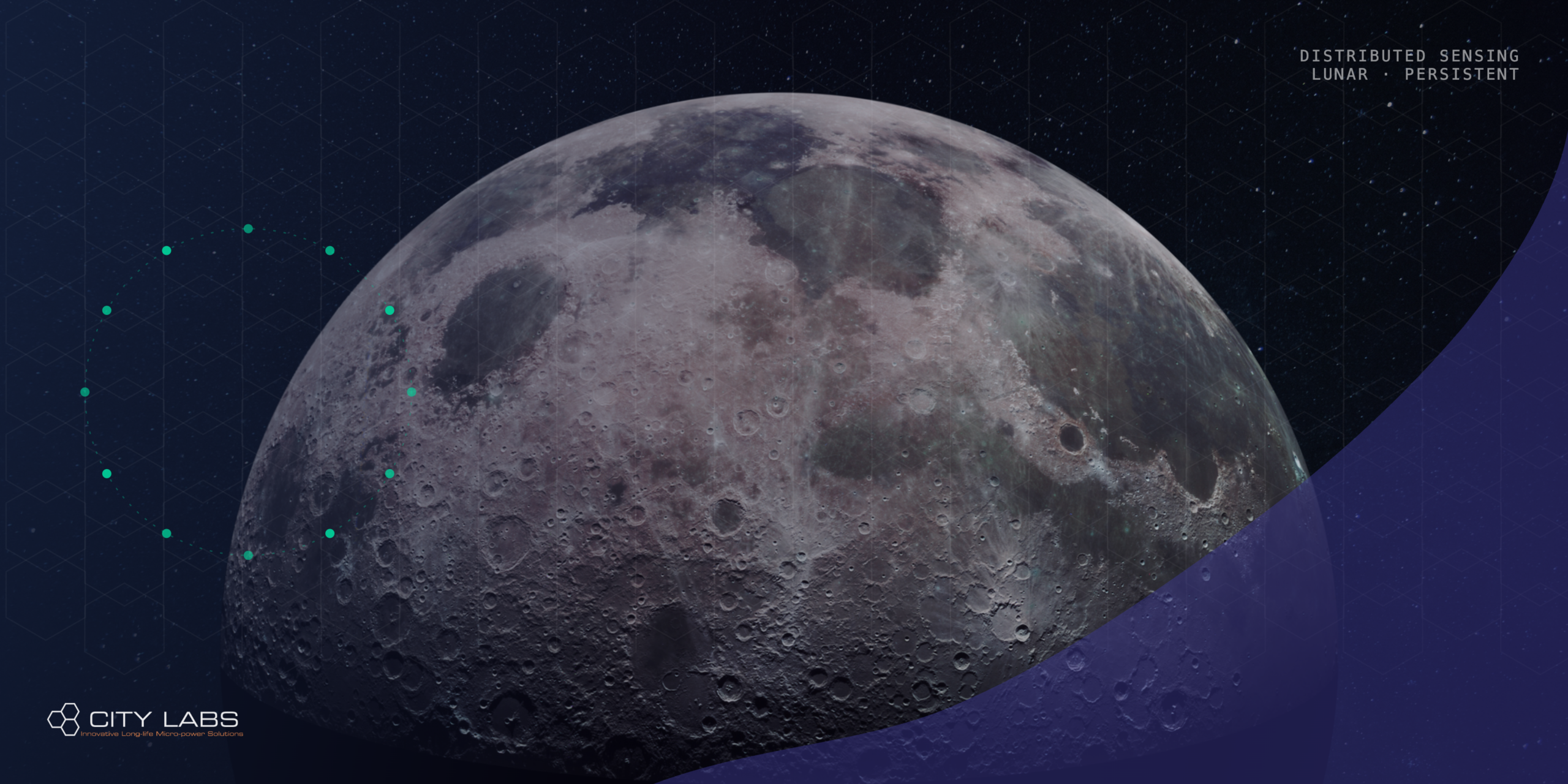
Distributed sensor networks are becoming a core component of lunar surface architecture—deployed across wide areas to monitor seismic activity, radiation levels, thermal conditions, and surface interactions. The sensing technologies themselves are mature. What constrains these systems isn’t measurement capability; it’s how long they can operate once deployed.
For sensor nodes that must run autonomously for years without maintenance or battery replacement, power system design is the central engineering problem. Conventional approaches don’t solve it cleanly—and the gap between what’s needed and what solar plus storage can reliably deliver is where nuclear micropower becomes relevant.

Lunar Surface Sensors Are Power-Constrained by Design
Lunar surface environments combine several constraints that are difficult to address simultaneously with conventional power approaches. Solar availability is intermittent, with 14-day darkness periods that require systems to bridge extended gaps without any energy input. Temperature swings of nearly 300°C across the day-night cycle stress battery chemistry and affect overall system reliability. Once deployed, sensor nodes have no access to maintenance or replacement—long-term reliability is a design requirement, not a contingency. And because each node must remain compact, large energy storage systems aren’t a viable solution.
For sensing applications that require continuous operation—seismic monitoring, radiation mapping, regolith analysis—these constraints compound. Gaps in power don’t just pause the system; they produce incomplete datasets and reduce the scientific value of the entire deployment.

Distributed Sensor Networks Amplify These Constraints
Lunar missions are moving from single centralized instruments to distributed networks of smaller sensor nodes. That shift changes how power systems must be evaluated. Each node typically requires only microwatts to milliwatts of continuous power—but that requirement holds across dozens or hundreds of nodes, indefinitely.
Storage-heavy approaches don’t scale well in this context. Increasing battery capacity to extend runtime adds mass and complexity at the node level and introduces additional failure points across the network. A power architecture that works for a single system may not remain practical when replicated across an entire sensor network. What’s needed is a continuous, low-level energy supply that doesn’t grow more complex as the deployment grows larger.
Continuous Micropower for Baseline Energy
The primary requirement for distributed lunar sensors isn’t high power output—it’s a stable, uninterrupted energy supply that doesn’t depend on environmental conditions. That’s the operational profile nuclear micropower systems are built for.
Tritium-based micropower devices generate electricity through beta decay, using solid-state semiconductor structures to convert emitted particles directly into electrical energy. The process is continuous and passive—no recharge cycles, no moving parts, no dependence on sunlight. Output is defined by isotope decay rate, which means performance is predictable across the full device lifetime.
For lunar sensor nodes, this translates to uninterrupted support for sensing, data logging, and low-power electronics regardless of solar availability. The 14-day lunar night doesn’t affect the underlying power-generation mechanism. Rather than storing energy for later use, micropower systems generate it steadily from day one, simplifying system architecture and reducing the long-term failure modes that come with cycling storage components.

Designing for Lunar Deployment
In practice, micropower systems work best as part of a broader power architecture rather than in isolation. Many lunar sensor applications require a combination of continuous baseline power and short-duration energy bursts for data transmission or sensor activation events.
Hybrid architectures address this by pairing micropower generation with small batteries or capacitors. The micropower system maintains baseline operation continuously, while stored energy handles intermittent peak loads—without requiring the large-scale storage that would otherwise be needed to bridge the lunar night. Thermal integration can pair betavoltaic systems with RHUs or localized heating strategies to improve survivability at temperature extremes. And because micropower sources are compact and solid-state, they support modular packaging that scales cleanly across many nodes without adding system complexity.
The result is a “deploy and forget” architecture: each sensor node operates independently for years, with no intervention required after placement.
City Labs and Persistent Lunar Power
City Labs’ NanoTritium™ batteries are built for exactly this operational profile: long-duration, low-power operation in environments where maintenance isn’t an option. Tritium-powered and solid-state, they deliver continuous micro-power without solar input, recharge cycles, or moving components.
For lunar surface sensor networks, that means a reliable baseline power level for autonomous operation, reduced dependence on large energy storage, and a power architecture that scales across nodes without compounding design risk. As lunar missions push toward persistent, distributed infrastructure, NanoTritium™ battery technology provides the steady, maintenance-free foundation those systems depend on.
Explore City Labs’ space power applications to learn how micropower supports autonomous sensor operation in extreme environments.