
January 2026 | Tips & Information
Are Nuclear Batteries Safe for Medical Implants?
Medical-device developers are increasingly evaluating long-life “nuclear batteries” as an alternative to traditional lithium chemistries—especially for implants that need decades of continuous power. These devices use low-energy radioactive isotopes to generate electricity in a fully sealed package, offering exceptional reliability in applications where replacement surgery carries significant risk.
Yet you may be wondering: Are nuclear batteries truly safe to put inside the human body?
This article explains how nuclear batteries work, how they are regulated, and why they are now being considered for next-generation pacemakers, biosensors, and long-life implantable systems. Throughout, you’ll find links to additional background on City Labs’ work, including the company’s NIH-funded collaboration with BIOTRONIK to advance and develop tritium-powered leadless pacemakers.

What Are Nuclear Batteries for Medical Implants?
Nuclear batteries—also known as betavoltaic batteries—convert energy from a low-level radioactive source into a steady electrical output. Despite what the word “nuclear” might imply, these devices do not contain fissile materials and cannot undergo a chain reaction. Instead, they use benign isotopes such as tritium, a hydrogen variant that emits extremely low-energy beta particles.
Tritium-based batteries are uniquely positioned for medical use because the isotope can be embedded inside a solid-state, shatter-proof structure, preventing it from interacting with surrounding tissue. City Labs’ NanoTritium™ betavoltaic batteries are one such example: the radioactive material is permanently sealed inside a semiconductor architecture designed specifically for long-life micro-power applications.
How Nuclear Batteries Work in Implantable Medical Devices
At their core, nuclear batteries use the interaction between a beta-emitting isotope and a semiconductor junction to generate a continuous DC output. As beta particles strike the semiconductor, they create electron-hole pairs; these charges are collected to produce electricity. The process is passive, reliable, and extremely stable.
Key advantages for implantable systems include:
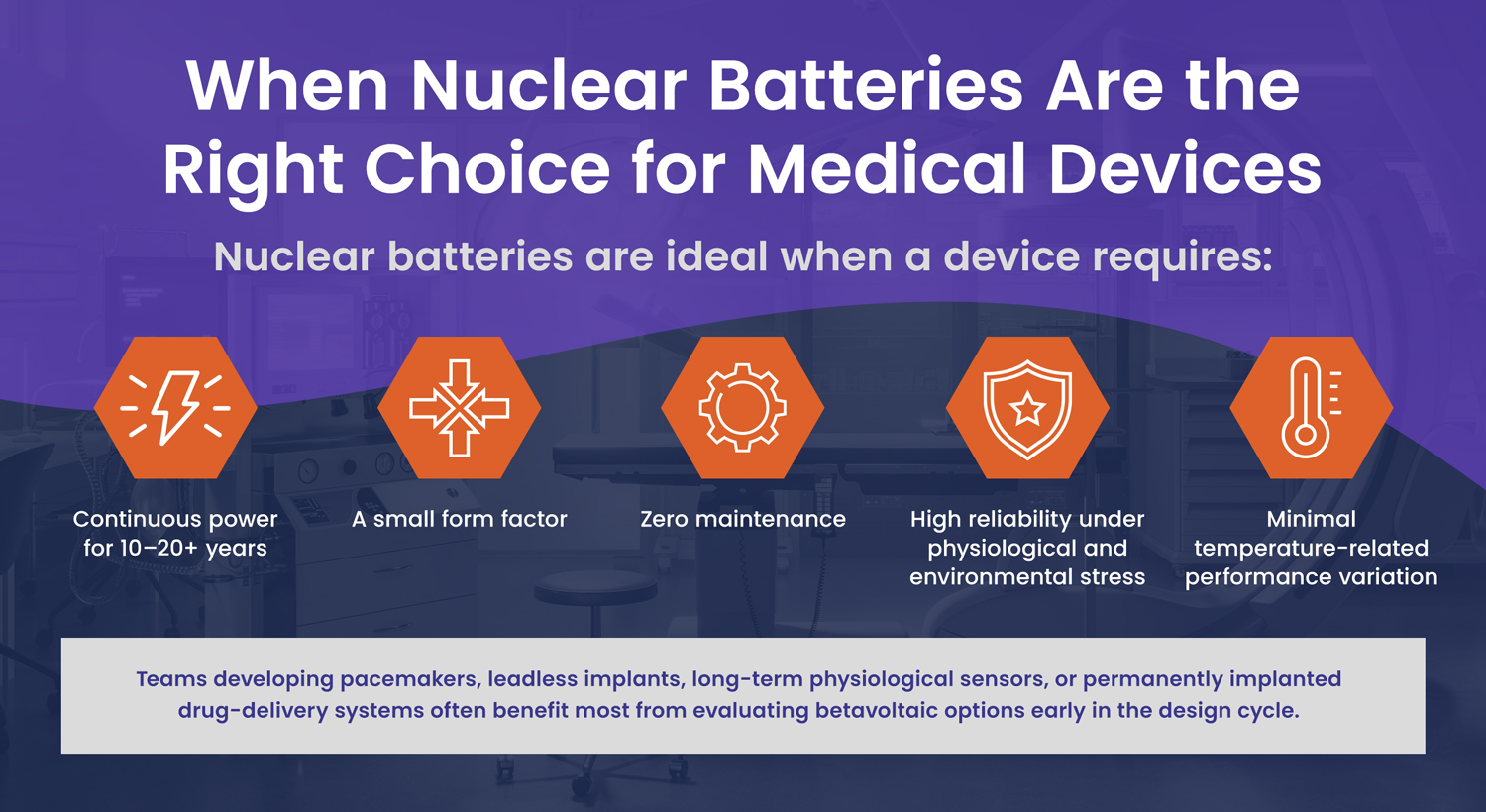
- Longevity: Tritium’s half-life of 12.3 years allows for consistent long-term performance—often decades—without recharging.
- Miniaturization: Betavoltaics can be manufactured at millimeter scale, ideal for pacemakers, leadless implants, and biosensors where form factor is critical.
High Reliability: Because they have no moving parts and no chemical degradation mechanisms, nuclear batteries sustain output even under extreme temperature, vibration, or humidity conditions.
Are Nuclear Batteries Safe for Human Use?
Safety is the defining requirement for any energy source that will be implanted inside the body. Nuclear batteries are engineered with multilayer protections to ensure that radiation is fully contained and that the device remains stable through the entire lifecycle.
Radiation Containment
Radioactive isotopes emitted by NanoTritium™ batteries are sealed within each battery’s careful packaging. In tritium devices, beta particles are so low energy that they cannot penetrate even thin surfaces, meaning all emissions are absorbed before reaching tissue.
Decades of Field Testing
Low-energy nuclear sources have been studied for medical power applications for more than half a century. Modern versions use refined manufacturing, predictable degradation characteristics, and stable output—features that are essential for implants requiring continuous power with minimal failure risk.
Safety Standards and Certifications
Nuclear batteries used in medical devices are subject to rigorous safety and regulatory controls governing radioactive materials, device integrity, and lifecycle management. City Labs details these requirements in its nuclear safety measures, which describe the engineering safeguards, laboratory protocols, and regulatory oversight applied from manufacturing through end-of-life.
City Labs is the first betavoltaic battery manufacturer to receive a Product Regulatory General License, authorizing the manufacture, sale, and distribution of its NanoTritium™ power sources. These devices contain small, sealed quantities of tritium—a low-energy radioisotope commonly used in consumer products such as exit signs and diver’s watches. The general license confirms that the radioactive material is permanently contained and safe for widespread commercial use, while also eliminating the need for end-user radiation licensing or specialized radiological training.
Together, permanent encapsulation, radiation-containment verification, and long-term mechanical and environmental testing ensure that all emissions remain fully confined within the device structure. Because tritium-based nuclear batteries use solid-state architectures and contain no liquid electrolytes, they also avoid thermal runaway and leakage failure modes associated with lithium-ion implant power sources.
Proven Use Cases of Nuclear Batteries in Medical Technology
Several implant categories benefit from long-life, maintenance-free power:
Pacemakers and Cardiac Devices
Continuous-power cardiac implants—especially miniaturized, leadless pacemakers—are prime candidates for nuclear micro-batteries. City Labs has received NIH support to develop tritium-powered pacemakers alongside BIOTRONIK.
Long-Life Bioimplants
Sensors for thermodynamic monitoring, neurostimulation, glucose tracking, and other chronic-condition applications need predictable multi-year power. City Labs outlines several of these use cases on its bioimplant overview page.
Why Longevity Matters
Every replacement surgery introduces risk—anesthesia, infection, scarring, and device-handling complications. A decades-long power module meaningfully reduces cumulative surgical risk and total system cost.
Cost, Supply, and Reliability Considerations
Engineers evaluating nuclear batteries often ask about cost and sourcing. The factors to consider include:
- Stable Supply Chain: Tritium is commercially available and regulated, with well-established purification and encapsulation processes.
- Total Cost of Ownership: While unit prices can be higher than lithium batteries, overall system costs decrease when battery replacements and associated surgeries are eliminated.
- Scalability: Betavoltaic modules are semiconductor-fabricated, enabling high repeatability and strong quality control for OEM production.
More detail on device-specific implementations is available on City Labs’ pacemaker applications page and medical-device landing page.
Learn More About Medical Battery Innovation
To explore additional use cases, device architectures, and integration approaches, visit City Labs’ medical applications hub.
If you’re curious how City Labs can help you power your next medical implant breakthrough, contact us today.
Frequently Asked Questions
No. The radioactive source is fully sealed, and low-energy emissions cannot escape the device housing.
The beta particles emitted by tritium are fully absorbed within the battery structure.
Medical-device testing includes hermeticity, biocompatibility, radiation-containment verification, mechanical durability, and long-term reliability assessments.
Tritium batteries can provide stable output for decades, depending on power draw.
Yes. Research and early devices date back decades, and modern versions incorporate advanced solid-state safety features.
Unit cost can be higher, but overall cost is often lower over the device’s lifetime because replacements are minimized.
Yes—this is one of the primary advantages of nuclear batteries, as it drastically reduces surgical risks.
Are nuclear batteries dangerous inside the body?
How much radiation do nuclear batteries emit, and is it contained?
What tests or certifications prove nuclear battery safety?
How long do nuclear batteries last?
Have nuclear batteries been used in medical devices before?
Are nuclear batteries more expensive than lithium-ion implants?
Can nuclear batteries reduce the number of replacement surgeries?